The rulebook
How to play Settletiles
Three or four players, an island of 19 hex tiles and a race to 10 points. You roll for resources, trade for what you're missing and turn it into roads, villages and castles. Every rule is on this page.
The short version
- Your turn starts with two dice. Every tile showing that number pays everyone who has built on its corners.
- Trade with the other players or with the bank for the cards you're short of.
- Spend cards on roads, villages, castles and fortune cards.
- A 7 pays nobody. Big hands lose half, and the thief moves.
- The first player to reach 10 victory points on their own turn wins.
The island
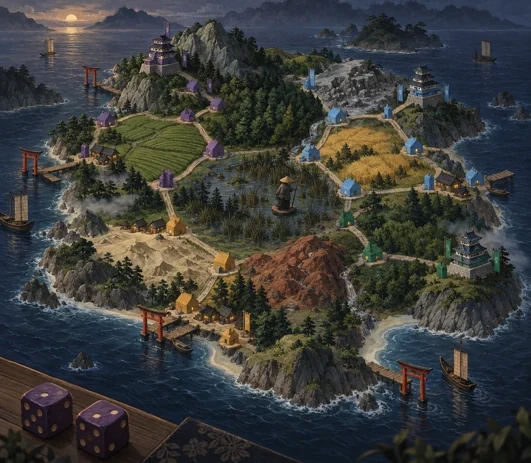
The board is an island of 19 hex tiles: four woodlands, four meadows, four rice paddies, three clay pits, three peaks and one swamp. Every tile except the swamp carries a number token from 2 to 12. The thief starts on the swamp.
Each kind of land pays one kind of card, and everything you build is paid for with these five.
 Timberfrom the woodland
 Clayfrom the clay pits
 Silkfrom the meadow
 Ricefrom the rice paddies
 Stonefrom the peaks
Nine harbors sit around the coast. Four of them are general harbors, and each of the other five names one resource. They matter once you start trading with the bank.
Setting up
Everyone places two villages and two roads before the first roll. Placement goes around the table and then back again. In the first round, each player places a village on a free corner and a road touching it. The second round runs in reverse, so whoever placed last in round one places first in round two.
Your second village pays out at once: one card for every land tile it touches. The swamp gives nothing.
One rule holds all game long: no two buildings ever stand on neighboring corners, yours included. Every village keeps at least one empty corner between itself and the next building.
Rolling for resources
Every turn starts with a roll of two dice. Each tile with that number pays one card to every village on its corners and two cards to every castle, whoever rolled.
Some totals come up far more often than others. The dots under each number show how many of the 36 ways two dice can land make that total. The 6 and the 8 are red because they come up most. The 2 and the 12 are the rarest.
- 2•
- 3••
- 4•••
- 5••••
- 6•••••
- 8•••••
- 9••••
- 10•••
- 11••
- 12•
| Roll | Ways out of 36 | Chance per roll |
|---|---|---|
| 2 or 12 | 1 | 2.8% |
| 3 or 11 | 2 | 5.6% |
| 4 or 10 | 3 | 8.3% |
| 5 or 9 | 4 | 11.1% |
| 6 or 8 | 5 | 13.9% |
| 7 | 6 | 16.7% |
Now and then the bank runs short. If it can't pay everyone who is owed a resource on a roll, nobody gets that resource on that roll. If only one player is owed it, they take whatever is left.
Trading
After the roll, the player whose turn it is can trade. Every trade involves them: two other players can't trade with each other on someone else's turn. Both sides have to hand over at least one card, so there are no gifts, and you can't swap a resource for more of the same one. Fortune cards never change hands.
The bank always trades, at a price. Four cards of one kind buy any one card. A harbor on a corner where you've built makes it cheaper: three of a kind at a general harbor, or two of the resource a special harbor names.

Building
You can trade and build as often as your cards allow, in any order, until you pass the dice. These are the prices:
-
 RoadMust touch one of your roads, villages or castles.
=
RoadMust touch one of your roads, villages or castles.
=
-
 Village1 point. Must stand on one of your roads.
=
Village1 point. Must stand on one of your roads.
=
-
 Castle2 points. Replaces one of your villages and pays double.
=
Castle2 points. Replaces one of your villages and pays double.
=
-
 Fortune cardDrawn from the top of the deck.
=
Fortune cardDrawn from the top of the deck.
=
Each player owns 15 roads, 5 villages and 4 castles. A castle gives its village piece back, so you can build that village again somewhere else. When a piece runs out, that kind of building waits until one comes back.
The thief
On a 7 the land pays nobody. First, anyone holding more than seven resource cards returns half of them to the bank, rounded down. Fortune cards don't count.
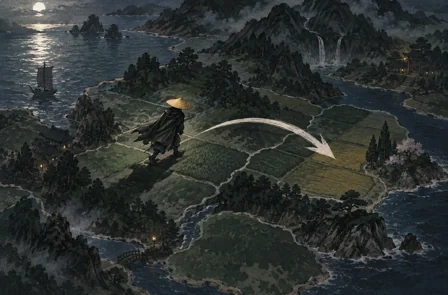
Then whoever rolled must move the thief to a different tile and takes one random card from a player who has a building on it. While the thief stands on a tile, that tile pays nothing, even when its number comes up.
Fortune cards
The deck holds 25 cards. You can buy as many as you can pay for, but you may play only one per turn, and never on the turn you bought it. You may play it at any point of your own turn, even before you roll.
| Card | In the deck | What it does |
|---|---|---|
| Guard | 14 | Move the thief and take a card, exactly as on a 7. The guard stays face up and counts toward Guard Captain. |
| Road Crew | 2 | Lay two roads for free. |
| Windfall | 2 | Take any two resource cards from the bank. |
| Hoard | 2 | Name a resource. Every other player hands you all of theirs. |
| Victory point | 5 | One point each: the Stone Lantern, the Tea House, the Bathhouse, the Watchtower and the Old Pine. They count as soon as you draw them and stay face down. |
Road Master and Guard Captain
 Road Master, 2 points
 Guard Captain, 2 points
The first player with a road of five pieces end to end becomes Road Master. Branches don't count, only the longest single line. Someone else takes the title only by building a strictly longer road; matching it isn't enough.
Another player's village built on a corner along your road breaks it in two. Your own buildings never do. If a broken road leaves you still tied for the longest, you keep the title. If two other players now tie for the longest, or nobody has five in a row anymore, the title goes to the side until one road is longest on its own.
The first player with three guards face up becomes Guard Captain. The title passes on only to someone with more guards than the holder.
Winning
| What you have | Points |
|---|---|
| Each village | 1 |
| Each castle | 2 |
| Road Master | 2 |
| Guard Captain | 2 |
| Each victory point card | 1 |
The first player to have 10 points on their own turn wins. If you reach 10 during someone else's turn, for example because a road broke and Road Master came to you, you win when your own turn comes, as long as you still have 10.
Playing on Settletiles
Settletiles runs in your browser, with nothing to install.
- Against the computer: pick how hard the bots play and take as long as you like. Easy and Medium are ready now; Hard and Impossible are coming.
- With friends: host a table and send your friends the game id, or sit down at an open table. Online tables keep a turn clock, so the game keeps moving.
- Saving: the game saves after every turn. Your islands are kept with your account, so they follow you to any computer.
- Account: playing needs a free account, by email or with Google. You can read these rules and the leaderboard without one. There are no ads.
Two expansions are on the way: Open Sea and Guilds & Garrisons.
Play your first island
The quickest way to learn is a game against the bots. It saves after every turn, so you can stop whenever you like.
Play free in your browserQuestions people ask
How many players?
Three or four. Against the computer, bots take the other seats. Online, you host a table for your friends or join an open one.
Is Settletiles free?
Yes. It runs in the browser and shows no ads. You need a free account so your islands and results are saved.
Can I play a fortune card before I roll?
Yes. You get one per turn, at any point of your own turn, including before the dice. It can't be a card you bought that same turn.
Can I trade when it isn't my turn?
Only with the player whose turn it is. Two players who aren't on turn can't trade with each other.
Do my own villages break my road?
No. Only another player's village or castle splits a road.
What happens when I hold more than seven cards on a 7?
You return half your resource cards to the bank, rounded down. With nine cards you give back four. Fortune cards don't count and are never taken.